Not every talking toy needs a large language model.
Some products only need to record a message and play it back later. Others need open-ended conversation, multilingual responses and a cloud AI Agent. These are very different product architectures, even though both may be described as a “voice toy.”
Understanding the difference early can save unnecessary cost and development time.
Architecture 1: Local Record-and-Playback
A local recording toy typically works like this:
Microphone → local audio storage → playback button or trigger → speaker
The product may allow a user to record a short message, greeting, story or sound effect and play it later without requiring internet access.
Typical advantages include:
- simple interaction,
- no cloud AI service,
- predictable behavior,
- low operating cost after purchase,
- offline playback,
- and a relatively small electronics scope.
This architecture is useful for personalized gifts, recordable plush toys, greeting products and simple talking toys.
Architecture 2: Cloud Conversational AI
A cloud AI toy works differently:
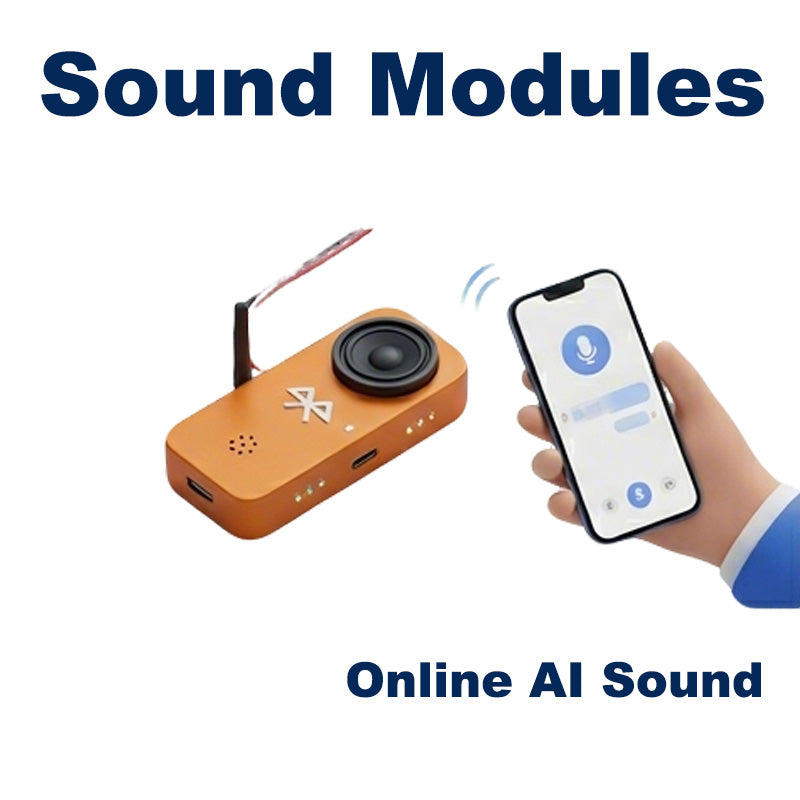
Microphone → speech recognition → AI Agent / model → generated response → text-to-speech → speaker
The response is created dynamically rather than being recorded in advance.
This enables:
- open-ended conversation,
- multiple languages,
- character personalities,
- changing knowledge or content,
- cloud updates,
- and more complex parent or app controls.
The tradeoff is that the product may need Wi-Fi or cellular connectivity, a cloud platform and an ongoing service architecture.
Local Audio Storage Is Not the Same as AI Memory
These concepts are often confused.
A local recording module stores audio files or recorded sound.
AI memory stores or retrieves structured information or conversation context that may influence future responses.
A toy can therefore have local sound storage without any AI memory at all, or it can have AI memory without storing complete raw audio recordings.
Keeping these concepts separate is important for privacy, storage planning and product specifications.
Cost Structure Is Different
A local recorder mainly creates hardware and firmware cost.
A cloud AI architecture may also include:
- speech recognition usage,
- model usage,
- text-to-speech usage,
- cloud hosting or platform services,
- data management,
- and optional app infrastructure.
For products that only need fixed or user-recorded audio, cloud AI may be unnecessary.
For products that need natural conversation, prerecorded audio alone will not deliver the expected experience.
Hybrid Products Are Also Possible
A smart toy can combine both approaches.
For example:
- local startup sounds,
- offline button-triggered phrases,
- parent-recorded messages,
- plus cloud AI conversation when connected.
A hybrid design can reduce cloud dependence for simple interactions while still supporting advanced AI functions.
Questions to Answer Before Choosing the Architecture
- Does the toy need open-ended conversation?
- Does the user need to record personal messages?
- Must playback work without internet access?
- How much local storage is required?
- How long are recordings expected to be?
- Does the product need multilingual conversation?
- Will there be an app?
- Is long-term cloud service acceptable for the commercial model?
- Are recorded files stored locally, in the cloud, or both?
- What happens when the device is reset or transferred to another user?
The Correct Choice Depends on the Product Goal
A recordable plush toy and an AI companion may look similar on the outside, but their electronics, software and operating models are fundamentally different.
At EmotiToy, we recommend defining the interaction goal first, then choosing the simplest architecture that can deliver it reliably.
Official Sources
- OpenAI Realtime API
https://platform.openai.com/docs/api-reference/realtime
- Tuya AI Agent Language Support
https://developer.tuya.com/en/docs/iot/agent-lang?id=Kekg6becm9z6g