When a brand starts an AI toy project, one of the first questions is often: Should we use ChatGPT or Gemini?
That question is understandable, but it is usually too narrow.
For a commercial AI toy, the real comparison is not simply one chatbot versus another. Product teams need to evaluate the complete developer stack behind the product: realtime voice, model behavior, latency, multimodal input, tool use, safety controls, regional deployment, cost, and how the chosen model connects to the device and AI Agent layer.
In practice, a better question is:
Which AI platform best fits this product architecture and target experience?
First, Separate the Consumer Brand From the API
“ChatGPT” is the consumer-facing OpenAI product. For an embedded toy, developers typically integrate OpenAI through APIs and current OpenAI models rather than embedding the ChatGPT app itself.
Likewise, Gemini-based products use Google's Gemini developer APIs and models.
This distinction matters because the available API capabilities, model names, realtime interfaces and pricing can change independently from the consumer apps.
For long-lived product documentation, manufacturers should therefore link to current developer documentation rather than relying on screenshots or old model names.
Realtime Voice Is More Important Than Text Benchmarks
Many AI toy comparisons focus on which model gives the “smartest” text answer.
For a voice-first toy, that is only one part of the experience.
The product also needs to handle:
- speech input,
- turn detection,
- interruptions,
- response latency,
- spoken output,
- session continuity,
- and network conditions.
OpenAI provides realtime APIs and audio APIs for low-latency interactive voice applications. Google provides Gemini Live API for realtime bidirectional interaction with audio, text and video input and native audio output.
For AI toys, these capabilities are often more relevant than general text-only benchmark comparisons.
Compare the Full Interaction Pipeline
A typical voice AI toy can follow a pipeline such as:
Microphone → local audio processing → cloud voice/model service → AI Agent logic → spoken response → speaker
Depending on the selected API, some stages may be combined into a realtime speech-to-speech experience while other architectures use separate ASR, model and TTS stages.
Product teams should compare both approaches.
A modular pipeline can offer clear control over ASR, model and voice services.
A native realtime voice model can reduce integration complexity and create more natural turn-taking.
The right choice depends on the product.
Latency Should Be Measured on the Finished Device
A model may look fast in a browser demo and still feel slow inside a toy.
End-to-end latency includes:
- microphone capture,
- local buffering,
- wireless transmission,
- cloud processing,
- AI Agent logic,
- audio generation,
- network return time,
- and playback buffering.
For this reason, teams should test OpenAI and Gemini on the actual target hardware and network architecture rather than comparing API marketing claims alone.
The relevant metric is not “model response time.”
It is:
How long does the user wait between finishing a sentence and hearing a useful response from the toy?
Multimodal Input Can Matter for Future Product Versions
Voice may be the first interaction mode, but some AI products eventually add:
- cameras,
- displays,
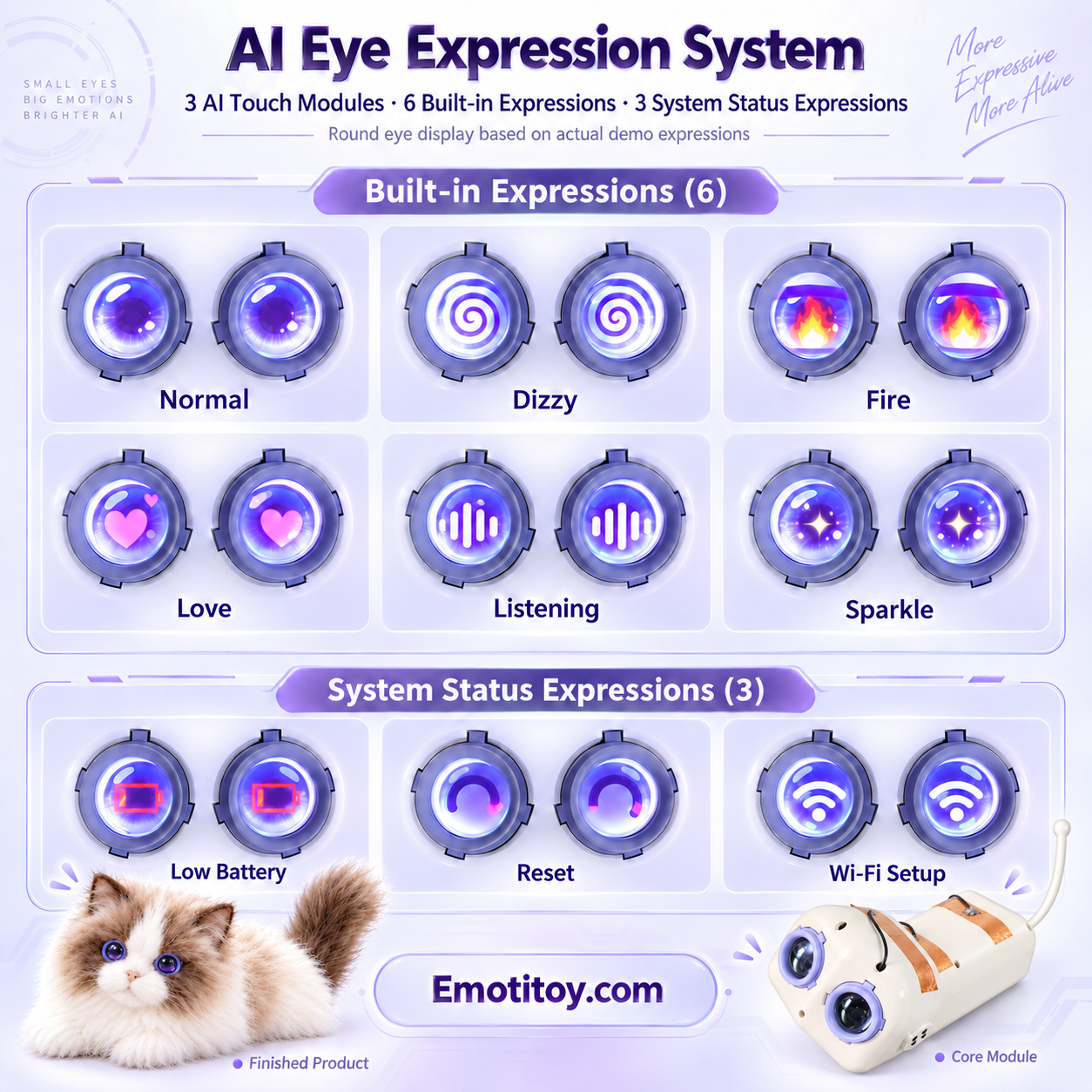
- electronic eyes,
- touch sensors,
- motion sensors,
- or visual recognition.
Gemini Live API publicly supports realtime audio, text and video interaction. OpenAI's current platform also supports multimodal model and realtime capabilities, with exact support depending on the selected API and model.
A product team planning only a microphone-and-speaker toy today may still want to evaluate whether the chosen platform can support future visual or sensor-driven product versions.
The AI Agent Layer May Be More Important Than the Model Brand
A branded toy usually needs more than a generic model response.
Its AI Agent may define:
- character identity,
- personality,
- language,
- approved knowledge,
- memory rules,
- conversation boundaries,
- device commands,
- and product-specific behavior.
Platforms such as Tuya can provide an Agent layer above third-party models. This allows the hardware and product logic to remain more stable even when the underlying model strategy changes.
That architecture can be useful for OEM/ODM programs because it reduces the temptation to design the whole product around one model name.
Model Choice Should Follow Product Requirements
There is no universal answer that one platform is always better for AI toys.
A team should define the product requirements first.
Useful comparison questions include:
- Does the product need native realtime voice?
- Which languages are required?
- Is visual input required now or later?
- Does the product need tool or device-control calls?
- Does it need a private knowledge base?
- How will memory be handled?
- What latency is acceptable?
- Which regions will the product be sold in?
- How will usage be measured and budgeted?
- Does the architecture need model-provider flexibility?
Only after those questions are answered does a model comparison become meaningful.
Language Support Must Be Tested in Voice, Not Only Text
A model can support a language in text while the final voice experience still performs poorly.
Voice products need to test:
- speech recognition,
- pronunciation,
- naturalness,
- accents,
- speaking speed,
- interruption handling,
- and target-market vocabulary.
A French, Arabic, German or Spanish AI toy should therefore be tested in that language on the actual voice pipeline.
The phrase “supports 80 languages” or “supports multilingual AI” should never replace product-level voice testing.
Cost Should Be Compared at the Interaction Level
Model pricing alone can be misleading.
A voice AI toy may consume several resource types:
- input audio,
- output audio,
- model tokens,
- conversation context,
- knowledge retrieval,
- and optional tools.
OpenAI and Google publish current API documentation and pricing, while an intermediary platform such as Tuya may have its own metering or service model.
For commercial planning, teams should calculate an expected cost per active device per month under realistic usage scenarios rather than comparing only a single token price.
Because platform pricing changes, any detailed price comparison should be dated and refreshed before publication or quotation.
Avoid Locking the Physical Product to One Model Name
A good hardware architecture should ideally remain useful even if the cloud AI strategy changes later.
For example, the physical product may define:
- microphone and speaker,
- Wi-Fi or cellular connectivity,
- firmware communication layer,
- device commands,
- OTA capability,
- and local controls.
The Agent/cloud layer can then handle model selection.
This separation can give a brand more flexibility as AI providers and model generations evolve.
Prototype Both When the Decision Matters
If OpenAI versus Gemini materially affects the product experience, the best comparison is often not a spreadsheet.
It is a controlled prototype test.
Use the same:
- hardware,
- microphone,
- network,
- character prompt,
- test questions,
- target languages,
- and evaluation criteria.
Then compare:
- response latency,
- voice quality,
- answer consistency,
- multilingual performance,
- interruptions,
- tool behavior,
- and resource usage.
This produces evidence that is specific to the product instead of a general internet debate about which model is “best.”
A Practical Architecture for Model Flexibility
For many AI toy projects, a useful structure is:
Toy hardware
↓
Device firmware and connectivity
↓
AI platform / Agent layer
↓
OpenAI, Gemini or another supported model/service
This keeps the product identity in the Agent and brand content rather than tying it entirely to one model provider.
The Best Model Is the One That Fits the Product
OpenAI and Gemini both provide powerful developer platforms for voice and multimodal AI.
For AI toys, the important decision is not which brand name is more popular.
The important decision is which architecture delivers the required language, latency, voice experience, control, scalability and commercial structure for the intended product.
At EmotiToy, we recommend evaluating the physical device and AI stack together. A successful AI toy is created by the interaction of hardware, connectivity, Agent design and cloud AI—not by the model name alone.
Official Sources
- OpenAI — Realtime API / Live Platform Reference
https://platform.openai.com/docs/api-reference/realtime
- OpenAI — Audio API Reference
https://platform.openai.com/docs/api-reference/audio
- OpenAI — Current Models
https://platform.openai.com/docs/models
- Google AI — Gemini Live API
https://ai.google.dev/gemini-api/docs/live-api
- Google AI — Gemini Live API Capabilities
https://ai.google.dev/gemini-api/docs/live-api/capabilities
- Tuya — AI Agent Development
https://developer.tuya.com/en/docs/iot/agent?id=Kdxnn04ancnc8