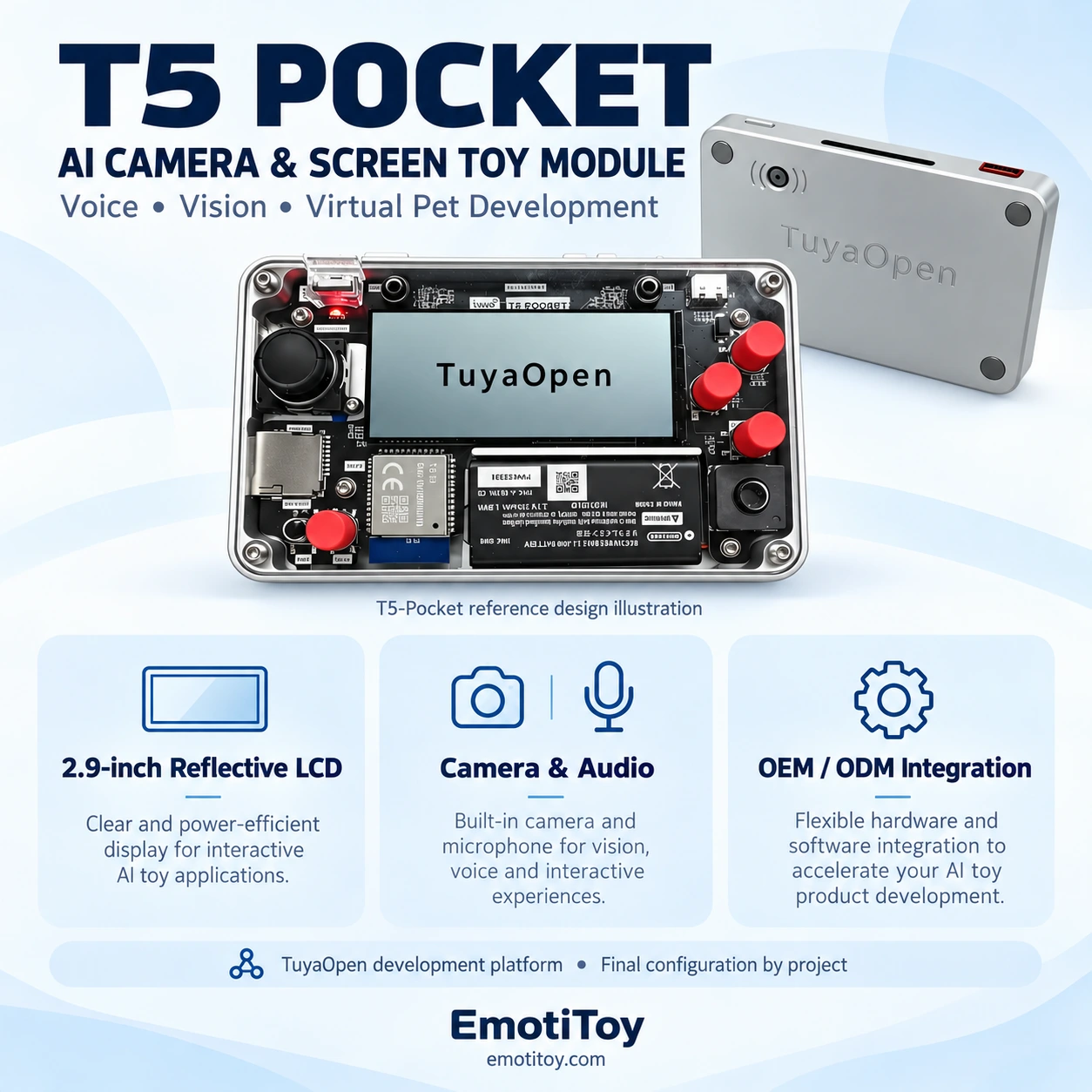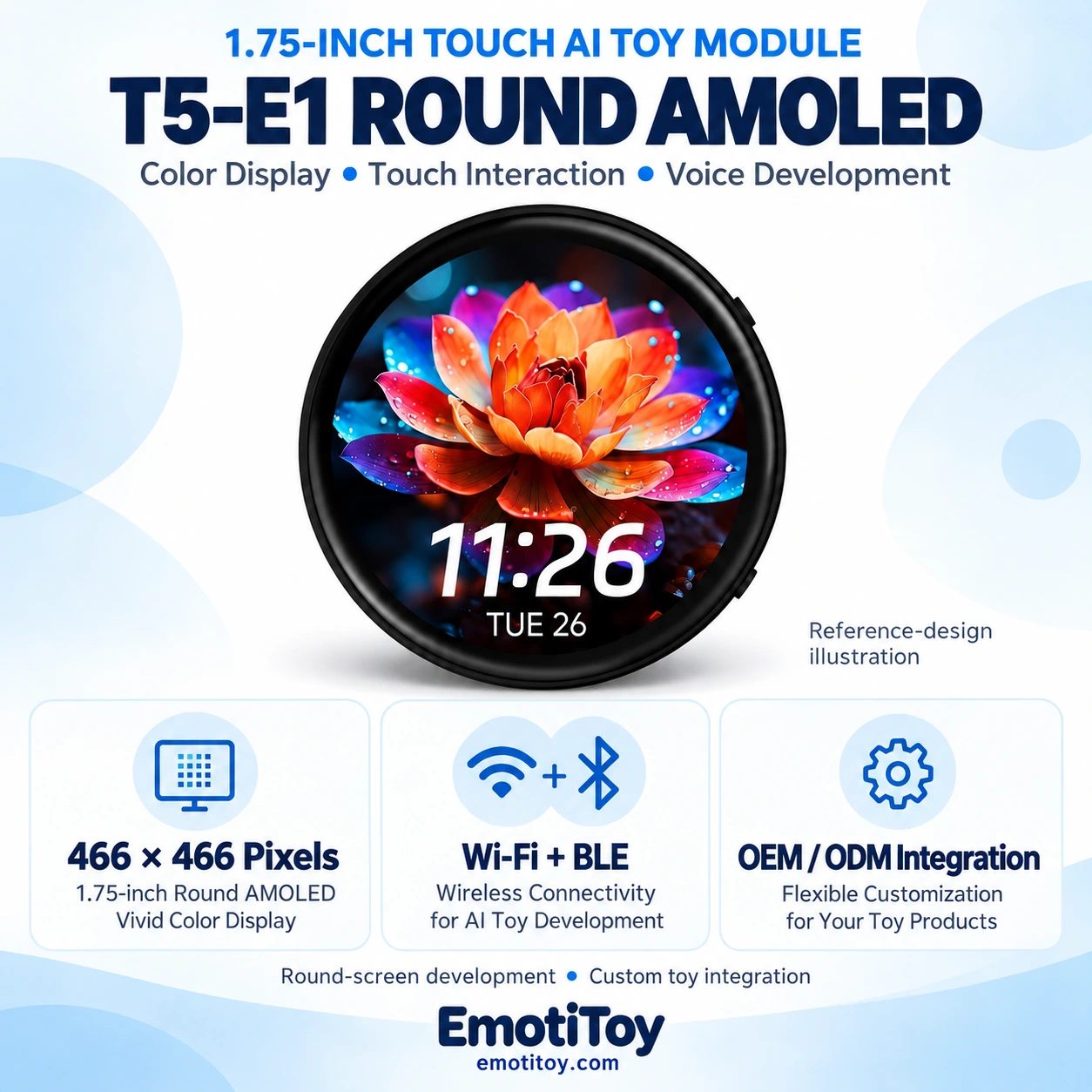

Choosing an AI toy platform begins with product ownership and delivery requirements. EmotiToy's existing Tuya/BK7258 route and an independent ESP32-S3 development route solve different procurement needs. Neither a chip name nor the word “open” defines the complete product.
Compare the Two Routes
| Decision | Existing Tuya-based product | Independent ESP32-S3 development |
|---|---|---|
| Starting point | A supported model and platform configuration | A selected board, firmware and service architecture |
| First evaluation | Test a working standard sample | Define a feasibility prototype |
| Buyer-owned AI backend | Not included as standard | Evaluated as a custom integration |
| Original device SDK | Not supplied as standard for existing cores | Rights and build deliverables agreed in scope |
| Character and movement | Must fit the selected electronics and frame | Custom electronics and mechanisms may be required |
| Service operation | Review platform terms and selected configuration | Allocate hosting, service costs and maintenance |
When a Standard Platform Fits
An existing product is useful when the buyer primarily needs a character with supported conversation, voice settings and defined physical functions. It provides a concrete sample for evaluating the experience before commissioning a new design. Confirm the exact version, supported languages, app behavior, motion and appearance using that sample.
Appearance customization still requires engineering review. A new head shape, smaller body or removable enclosure can affect acoustics, wiring and movement. Standard-platform sampling does not mean every cosmetic or functional change is included.
For EmotiToy's current Tuya/BK7258 configurations, do not assume original SDK access, arbitrary replacement firmware, buyer-supplied model-provider keys or a buyer-owned backend. A developer account or public chip documentation does not change the access available for a finished product.
When Independent Development Is Appropriate
A buyer needing its own AI service, device logic, app or control protocol should begin with an architecture assessment. ESP32-S3 is one hardware direction that can be evaluated with suitable firmware and services. It is not, by itself, a complete AI toy platform.
The public Xiaozhi client project documents a device-software architecture and MCP-based controls. The xinnan-tech server project is a separate backend reference. Upstream support does not establish that an EmotiToy board or finished toy already implements those features. Review selected revisions, dependencies, licensing and deployment requirements.
A domestic development-board demonstration also does not prove overseas service reliability. Test the intended networks, speech services, languages and reconnection behavior in the destination market.
Compare Costs Over the Product Lifecycle
Separate prototype charges, board and firmware development, enclosure tooling, integrated sampling and repeat-production unit prices. Connected products also need a service plan: who pays for speech recognition, model usage, speech synthesis, hosting and maintenance?
For standard configurations, confirm the current included usage and future service terms in the quotation; do not assume perpetual free service. For independent development, assign backend operation, accounts, credentials, updates and customer support explicitly.
Define Acceptance Before Choosing
Use the same conversation script, target language, acoustic setup and network conditions to compare routes. Test latency, interruption, microphone performance, movement noise, power consumption and loss-of-network behavior. Review the final plush or enclosure rather than only a bare board.
Espressif's audio front-end documentation describes audio-processing building blocks. Those functions require a compatible hardware and software integration and do not guarantee finished-toy performance.
Send a Decision Brief
Provide authorized character drawings, dimensions, mandatory and optional functions, target market, languages, quantity and backend ownership requirements. Identify whether the goal is a standard sample, appearance adaptation or an independent platform.
Explore buyer-owned AI integration, ESP32-S3 module development and our SDK/API/UART guide. Contact EmotiToy for a scoped assessment.
References reviewed October 24, 2026. This comparison describes project routes, not interchangeable firmware or a guaranteed performance comparison.