A working demo is not the same as a production-ready AI toy.
This distinction matters because AI products can look impressive very early. A microphone can send audio to the cloud. A model can answer. A speaker can play the response. That may be enough to prove the concept, but it does not yet prove that the product can be manufactured reliably, certified for the target market or supported after launch.
A practical development process separates several stages.
Stage 1: Concept Demo
The goal of a concept demo is to answer one question:
Can the core experience work?
For an AI toy, this may mean proving:
- voice input can be captured,
- the selected AI service can respond,
- text-to-speech is understandable,
- the basic character prompt works,
- a motion or touch concept is possible,
- or a mobile app can bind to the device.
At this stage, appearance and internal structure may still be temporary.
A development board on a table can be a valid demo if the goal is to test the AI conversation.
Stage 2: Functional Prototype
The functional prototype combines the core experience with the intended physical product.
This is where teams begin testing the real interaction between:
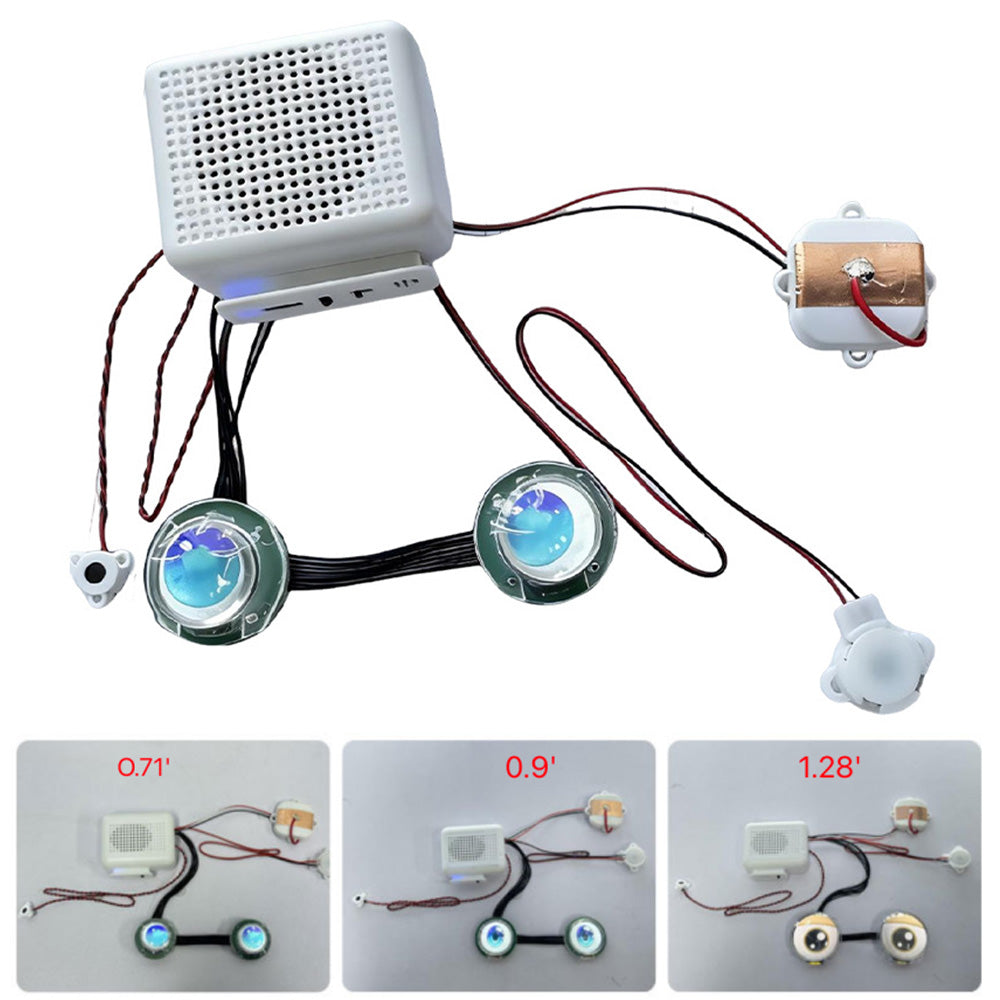
plush / enclosure + PCBA + battery + microphone + speaker + sensors + connectivity + AI
Important questions include:
- Can the microphone still hear clearly inside the product?
- Is speaker volume sufficient after fabric and stuffing are added?
- Does the battery fit safely?
- Does Wi-Fi or Bluetooth performance remain stable inside the enclosure?
- Do touch sensors trigger reliably?
- Do servos create too much noise near the microphone?
- Can the electronics be serviced or removed if required?
This stage exposes many problems that a desk demo cannot reveal.
Stage 3: AI Behavior Validation
The hardware may be working while the AI experience is still inconsistent.
A useful AI validation process should test repeatable scenarios rather than only casual conversations.
Test cases may include:
- greeting behavior,
- product identity,
- target-language conversation,
- unclear speech,
- unsupported questions,
- repeated questions,
- safety-sensitive prompts,
- offline or poor-network conditions,
- and recovery after interruption.
Tuya's Agent Evaluation and Agent Debugging tools are examples of platform-level systems that can compare expected and actual behavior and inspect stages such as ASR, model response and TTS.
Stage 4: Engineering Sample
The engineering sample should be much closer to the intended commercial configuration.
At this point, the team should be freezing or narrowing decisions around:
- materials,
- final dimensions,
- electronics architecture,
- battery,
- antennas,
- microphone and speaker,
- firmware,
- app configuration,
- AI Agent,
- mechanical motion,
- packaging direction,
- and target compliance requirements.
The purpose is no longer only to prove that the idea works. It is to identify whether the product can be repeated.
Stage 5: Pre-Production Validation
Before mass production, the product should be reviewed for manufacturing consistency.
Typical areas include:
- assembly sequence,
- wiring and connector control,
- production test points,
- firmware version control,
- serial or device identity management,
- final acoustic checks,
- charging behavior,
- packaging protection,
- and quality inspection criteria.
Connected products also need a plan for firmware updates and post-production maintenance.
Compliance Should Follow the Final Configuration
One common mistake is to assume that an early module report automatically covers the final toy.
The final product may introduce new materials, battery configurations, radio functions, wiring, accessories, packaging or age grading.
For US children's toys, CPSC guidance makes clear that the applicable toy requirements must be identified for the specific product and that covered children's toys require third-party testing and certification through a Children's Product Certificate.
The same product-specific principle applies in other markets.
A Good Demo Answers One Question; a Good Prototype Answers Many
A useful way to separate stages is:
Demo: Can it work?
Functional prototype: Does the experience work inside the intended product?
Engineering sample: Can the design be repeated?
Pre-production sample: Can it be manufactured, tested and supported consistently?
Do Not Over-Engineer V1
For a first commercial version, it is often better to prove a focused set of high-value functions than to combine every possible capability into one prototype.
A V1 might include:
- reliable voice interaction,
- one defined AI character,
- Wi-Fi connectivity,
- a parent or setup app,
- one touch interaction,
- and one or two expressive movements.
Advanced motion, custom apps, cellular connectivity or additional sensors can be added after the core experience is validated.
At EmotiToy, we treat prototype development as a risk-reduction process: each stage should eliminate a different category of uncertainty before the product moves closer to mass production.
Official Sources
- Tuya Agent Evaluation
https://developer.tuya.com/en/docs/iot/ai-agent-evaluation?id=Kenth7s0bxavo
- Tuya Agent Debugging
https://developer.tuya.com/en/docs/iot/ai-agent-debug?id=Kf9mfpv4wqycc
- CPSC Toy Safety Business Guidance
https://www.cpsc.gov/Business--Manufacturing/Business-Education/Toy-Safety