An AI desktop companion robot combines a physical character with sensing, a behavior controller and optional conversational AI. Voice, vision, electronic expressions and movement are separate systems: the product experience comes from coordinating them.
Voice, vision, movement and emotional interaction
| Layer | What it does | What it does not prove |
|---|---|---|
| Sound detection | Detects an acoustic event | Understanding spoken words |
| Sound-source localization | Estimates the direction of a sound using microphone signals | Identifying a person or a safe route |
| Speech recognition | Converts speech into text or an intent | Visual tracking or motor control |
| Vision | Detects objects, faces or a target in camera frames | Reliable identity or navigation in every environment |
| Behavior controller | Chooses permitted responses and coordinates timing | Unlimited autonomous reasoning |
| Electronic expressions | Displays listening, thinking, speaking and character states | Accurate measurement of human emotion |
| Motion controller | Executes bounded motor or servo actions | General-purpose walking or automatic docking |
| AI dialogue | Produces a conversational response from context | Direct authority to move the robot |
How a robot turns toward a voice
A microphone array can estimate sound direction from differences between microphone signals. The behavior controller may use that direction to request a head turn. Speech recognition follows a different path: it determines what was said. A single microphone voice toy can understand commands without being able to locate the speaker.
A request such as “come here” requires more than recognizing those words. The robot must select a target, decide whether movement is permitted, detect hazards and execute a motion sequence. Sound direction alone does not supply a distance or a safe path. Specify the expected behavior when multiple people speak, a television is playing or the sound is reflected by nearby surfaces.
LivingAI's EMO description provides a concrete product example of microphone-array sound direction detection and camera-based face recognition. These published features illustrate separate sensing channels; they do not establish the internal algorithm or an interchangeable OEM module.
Vision and electronic eyes serve different purposes
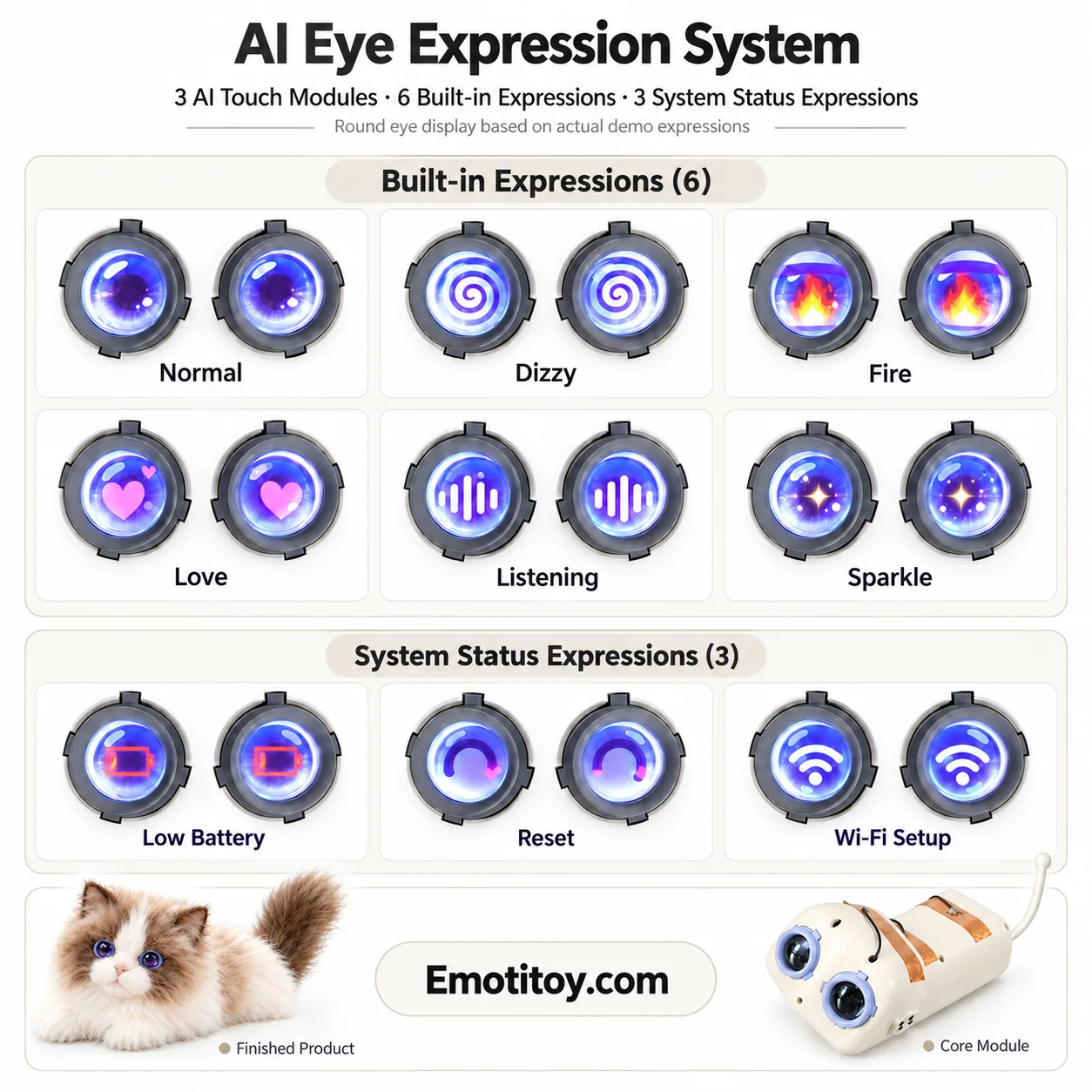
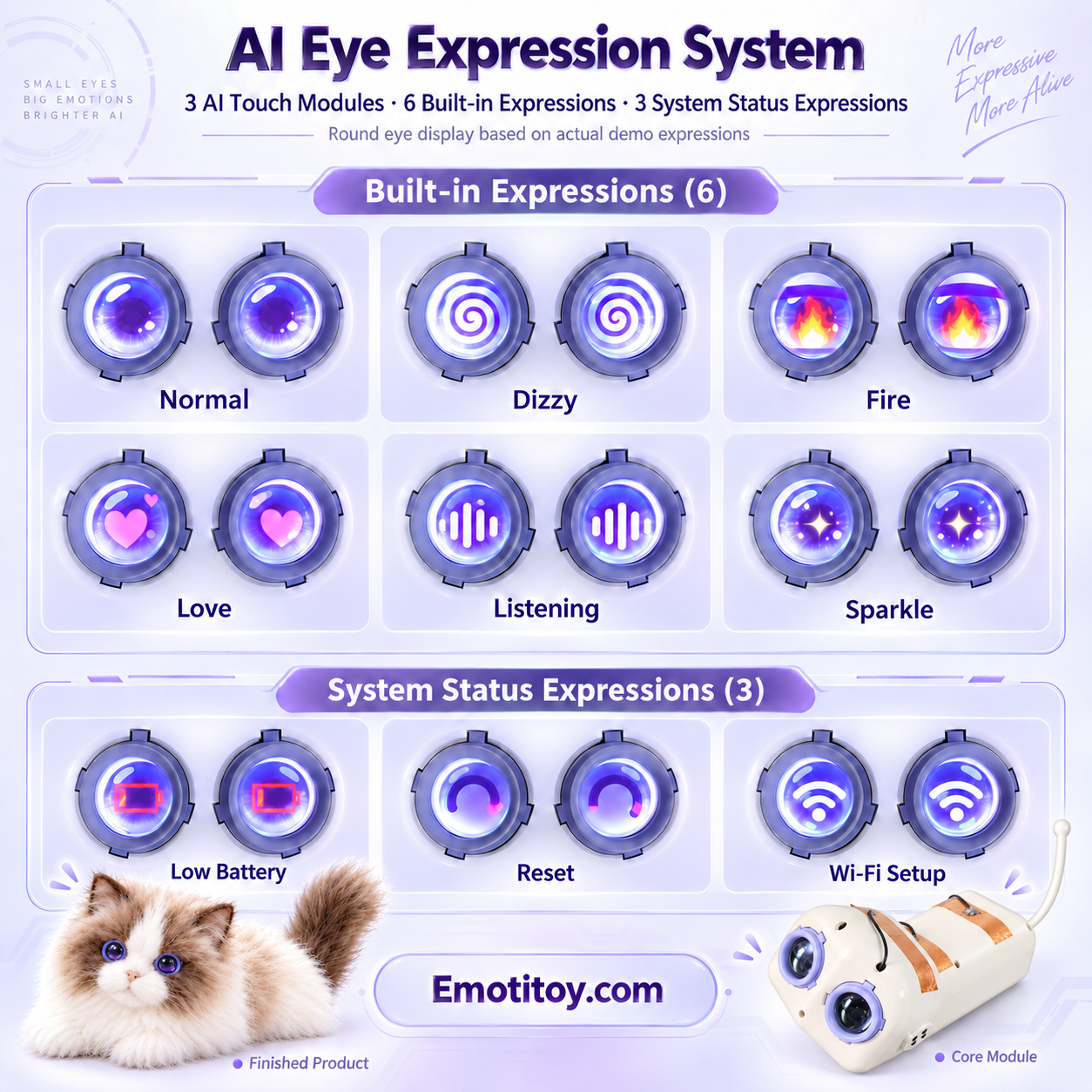
A camera supplies input. An electronic-eye display supplies output. Animated eyes can show that a robot is listening or speaking without a camera. Conversely, a camera-equipped product needs explicit software for face detection, recognition or tracking; adding a camera does not provide these functions automatically.
Define whether the project needs simple presence detection, remembered user identities, object recognition or continuous tracking. Validate the selected feature with actual lighting, viewing angles and the intended user distance. Decide what is processed locally, what leaves the device and which controls the user needs for camera and microphone operation.
Coordinate dialogue with physical actions
A useful interaction sequence is: a touch or voice event arrives; the device shows a listening state; speech is interpreted; a permitted action is selected; the response is spoken with matching expressions; the controller returns to an idle state. An interrupted response should stop its related audio and cancel any obsolete motion request.
For a custom design, the dialogue service can request named actions such as “gentle head turn.” Device firmware should validate those requests against an approved action list and limits for angle, speed and duration. Low-level motor limits belong in the device controller. A delayed cloud response must not trigger an old movement after the user has moved away.
Choose the motion architecture before the shell
| Product form | Main development questions |
|---|---|
| Stationary desktop character | Stable base, head and arm gestures, touch placement and acoustic design |
| Moving plush companion | Mechanism clearance, fabric drag, mass, noise and service access |
| Wheeled mobile pet | Traction, obstacles, floor transitions, target following and stopping |
| Bipedal desktop pet | Gait, balance, surface friction, edge sensing and fall recovery |
| Automatically charging robot | Dock detection, approach, alignment, charge confirmation and failed docking recovery |
Head turning and tail wagging are useful expressive features in their own right. Four-leg walking, sitting, two-leg walking and automatic charging require different mechanical and control work. Confirm each action separately on the proposed platform.
What emotional interaction means in a specification
An emotional AI robot may express a character's mood through animations, sounds and movement. That is different from reliably detecting a person's feelings. Specify observable responses: a greeting after a permitted presence event, a gentle motion after petting, or a quiet mode at selected hours.
A proactive AI companion starts an interaction without a fresh spoken command. It needs rules for timing, frequency, user permission and suppression during sleep or busy periods. Personality can be defined through prompts and behavior rules; persistent memory requires a separate design for storage, retention, editing and deletion.
An OEM development process that produces testable results
- Define the audience, setting, character, dimensions, markets, quantity and target cost.
- Write a behavior list, including offline behavior, silence, interruption and failure cases.
- Choose an existing platform or separate the additional electronics, firmware, mechanics and backend work.
- Demonstrate the core interaction on an engineering sample before locking the enclosure.
- Review the integrated sample for language quality, noise, motion range, runtime and charging.
- Agree the production configuration, validation plan, packaging and destination-market requirements before tooling and pilot production.
Sample approval should reference a specific version and checklist. For example, test wake-word response with the motor running, then repeat with a weak network connection. A successful quiet-room conversation does not validate performance beside a noisy actuator.
EmotiToy platforms and project boundaries
EmotiToy develops custom AI companion toys with voice interaction, electronic eyes, touch inputs and servo-driven character movement. See the AI robot toy OEM/ODM service and three-servo interactive cat module for current product directions.
This is the demonstration linked to the AI Walking Plush Robot. Review the visible and audible behavior and request a sample for the intended environment. This clip does not establish sound-source localization, camera tracking, bipedal walking or automatic docking for this product.
Those advanced capabilities require a dedicated feasibility review and demonstrated engineering results. Backend access, SDK availability, memory and language support must be agreed for the selected platform. Send a concept, a list of required actions and your expected quantity through project contact.
Related reading and source
- AI Companion Robot Trends in 2026
- SDK, API and UART integration guide
- LivingAI EMO: official product description
Technical architecture explanations are general development guidance, not a teardown of a branded robot. Product source checked on October 8, 2026.