A small turn of the head can make a plush character feel attentive before it says a single word. For brands developing interactive pets, that is a useful starting point: design the physical response as carefully as the conversation.
What is Mirumi, and how does it work?
Mirumi is a small bag charm robot from Japan's Yukai Engineering. Its official product description emphasizes head movements triggered by sound, touch and spontaneous behavior. It offers an example of companionship expressed through movement.
The official Japanese FAQ states that Mirumi has neither AI nor language recognition. Its arms hold around a bag strap mechanically; this should not be confused with electronic detection of attachment.
The official UK FAQ describes sound sensors on both sides of the body and a touch sensor on the back of the head. It also describes turning toward sounds and responding to petting. These are published product descriptions, not a teardown: they do not establish the exact controller, motor model or sound-processing algorithm.
Sound detection is different from speech understanding
For product development, three functions should be specified separately:
- Sound detection: noticing an acoustic event that can trigger a response.
- Sound direction detection: estimating a direction from which a sound arrives.
- Speech recognition: converting spoken words into information a language system can process.
A sound-reactive character does not automatically understand words. Likewise, turning toward a sound should not be advertised as visual tracking, face recognition or continuous person tracking without separate evidence.
For an original design, the useful specification is observable behavior: which sounds should trigger a response, how often it should react, and what should happen in a busy room. Those questions are more practical than assuming a particular competitor's internal implementation.
Touch response and motion behavior
In a custom plush robot, a touch event can request a head tilt, a short tail movement or a change of eye expression. A behavior controller then decides when to start, how far to move and when to stop. This is a general design model, not a claim about Mirumi's firmware.
The motion's timing matters. A short pause followed by a gentle turn gives a different impression from an immediate, fast movement. A prototype team can compare a few carefully defined sequences and select the ones that best fit the character.
Useful engineering terms include head pitch for up-and-down movement, head yaw for left-and-right turning, and servo-controlled motion for commanded movement using a servo motor. Embodied interaction describes the broader experience in which a physical body participates in the exchange through movement and touch.
Why simple movement can feel expressive
Our design interpretation is that an understandable response helps people connect an action with a character's behavior. Touching a plush and seeing it turn creates a small exchange, even without dialogue. This is a product-design observation, not a medical claim or proof of a particular hormonal response.
For a brand, the objective is to define its own character's behavior: curious, calm, playful or reserved. More movement is not automatically better. The right response should match the character, the available space inside the plush and the intended setting.
From reactive companions to AI plush robots
Conversational AI adds another interaction channel. An AI plush can combine touch events and programmed movement with spoken responses and animated eyes. The development task is to coordinate these channels so that they support the same character.
The EmotiToy AI Interactive Cat Module – 3-Servo Version provides a current platform example. Its published specification includes:
- Three independently controlled servos: head pitch from −30° to +45°, head yaw from −30° to +30°, and tail swing from −30° to +30°.
- Three independent touch zones and vibration feedback.
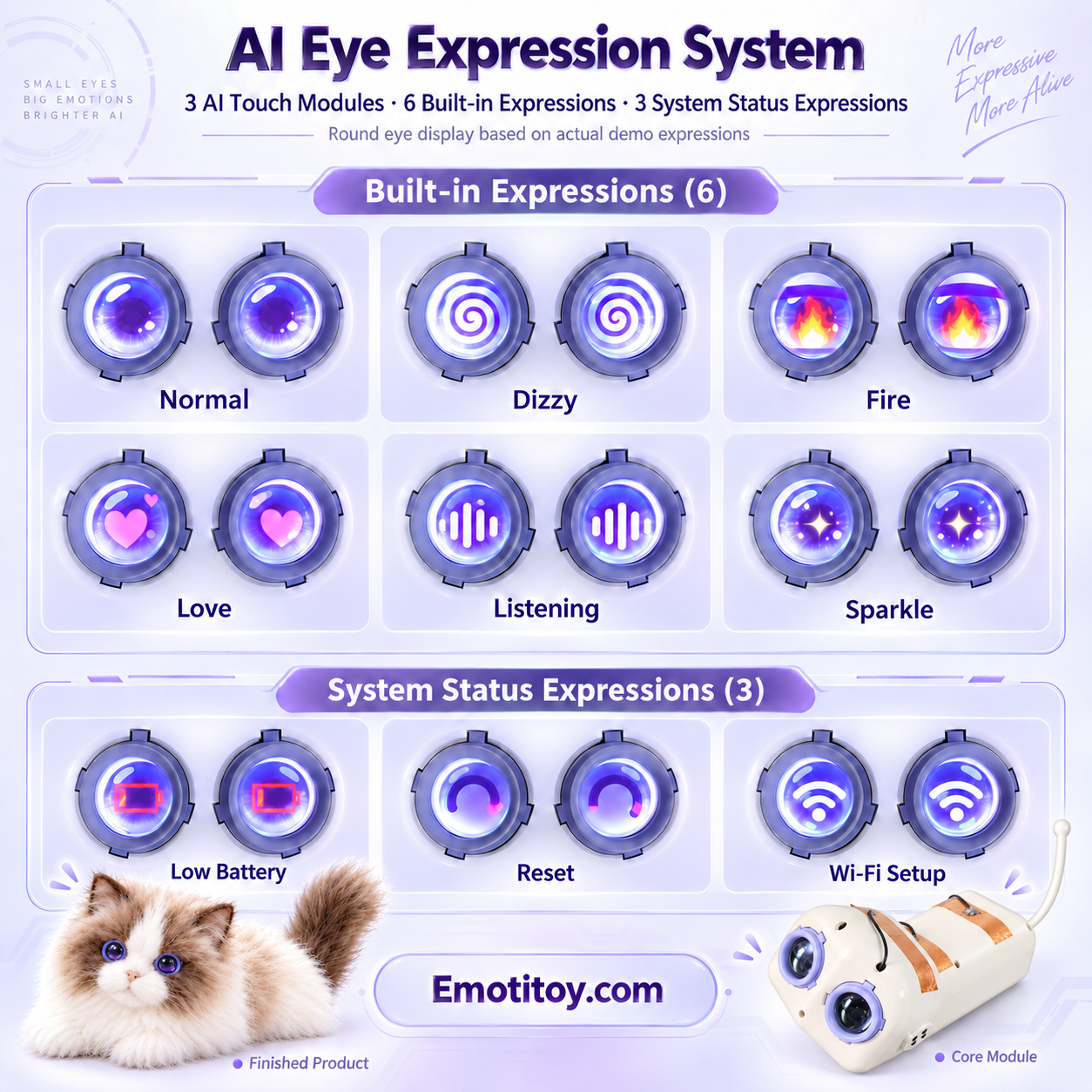
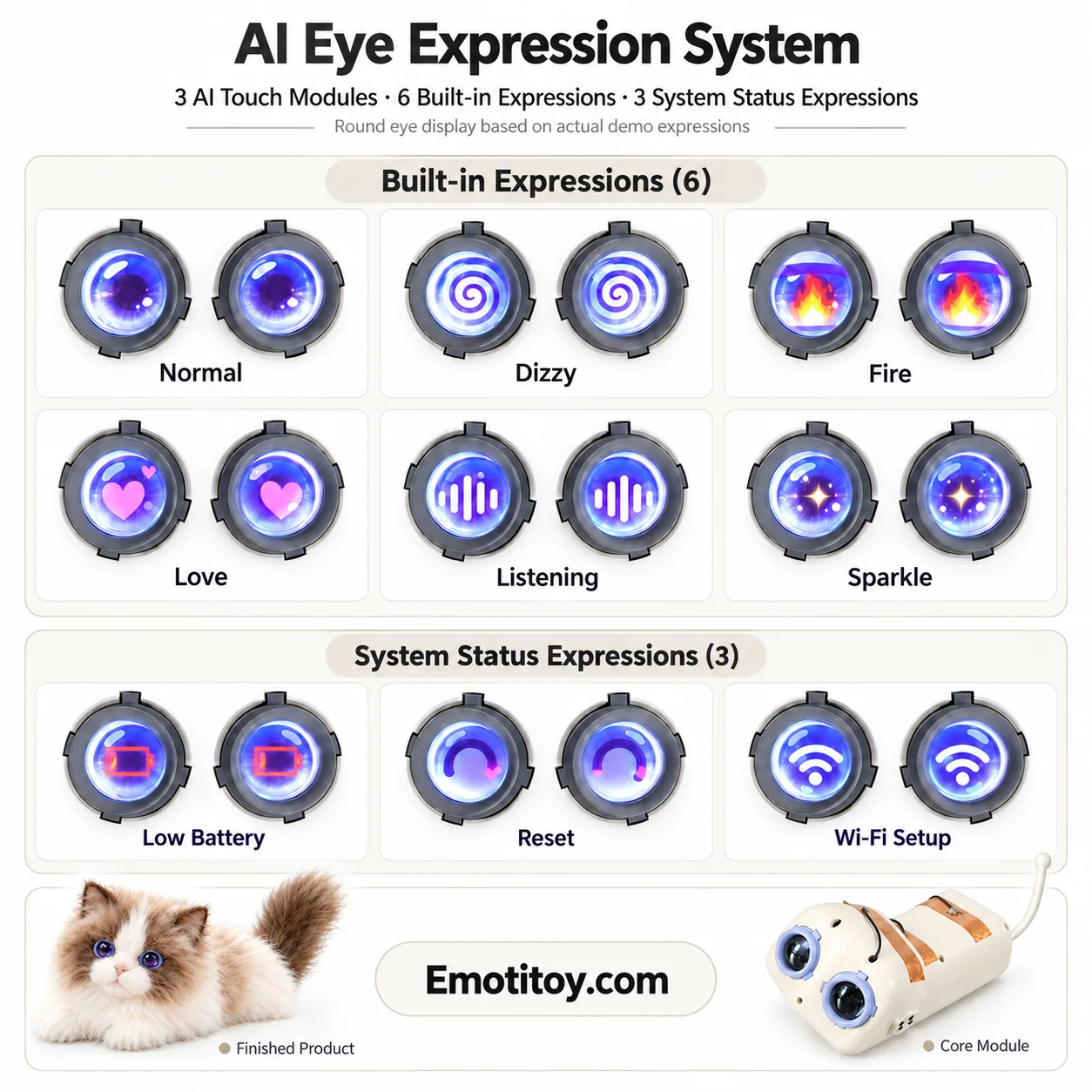
- Round electronic eye displays with built-in expressions and system-status animations.
- Programmable movement angles, speed, sequence and trigger conditions, with AI conversation and motion linkage.
These are module specifications. The finished character's usable movement must be checked after integration with its plush covering, internal supports and mounting arrangement. Programmable behavior also does not automatically mean unrestricted access to firmware or third-party AI services; the integration scope is agreed for each project.
| Interaction area | Mirumi: published description | EmotiToy AI Cat platform |
|---|---|---|
| Main experience | A small reactive bag companion | A module for custom AI plush and robotic pet projects |
| Conversation | No AI or language recognition | AI conversation and motion linkage |
| Touch | Head petting response | Three touch zones and vibration feedback |
| Movement | Reactive and spontaneous head movement | Programmable head pitch, head yaw and tail swing |
| Eyes | Character appearance | Electronic eye expressions |
| Sound direction | Turning toward sound is described | Under development; not a confirmed standard feature |
Development status, September 2026: EmotiToy is evaluating sound-direction response for future implementations. It should not be treated as an included, validated function of the current AI Cat module. Performance, sample availability and delivery timing require project-specific confirmation.
For more detail on movement planning, read How Servo Movement Changes an AI Plush.
Planning an original interactive plush project
Begin with the few interactions that matter most. Decide whether the product needs sound reaction, touch response, conversation, or a combination. Then confirm the character's height, the available internal space, the desired movements and whether it will sit on a surface or attach to a bag.
Bag attachment deserves its own structural evaluation. A motion module alone does not establish a secure grip. Strap dimensions, weight distribution, carrying movement and clearance around the moving head must be considered together.
A practical first step is to evaluate an existing functional sample, then develop the custom appearance and integrated structure. Explore EmotiToy's structural parts and AI plush toy manufacturing capabilities to frame the prototype scope.
Frequently asked questions
Does an interactive plush robot need conversational AI?
No. A design can focus on sensor-triggered physical responses. Conversation is an additional product choice with its own connectivity and integration requirements.
Does a sound-reactive robot track people?
Not necessarily. Detecting sound, estimating its direction and visually tracking a person are different functions. Specify and test the behavior actually required.
Can an existing motion module fit any plush character?
Fit must be evaluated. The character's size, internal volume, head weight, fabric resistance and mounting method influence the integration. A new outer appearance is not automatically a drop-in replacement.
Is sound-direction response available on the current EmotiToy AI Cat?
It remains a development item. The current published capabilities are the three-servo motion system, touch sensing, vibration feedback, electronic eyes and AI conversation linkage.
Developing an interactive plush robot?
EmotiToy supports evaluation of custom motion structures, touch interaction, electronic eyes, AI modules and OEM/ODM integration. Share your character reference, target size, key interactions, intended market and initial quantity through our project inquiry page.
Mirumi and Yukai Engineering are referenced as an independent industry example. EmotiToy is not affiliated with or endorsed by Yukai Engineering. The product image on this page shows EmotiToy's AI Cat technology.