AI companion robotics spans several distinct product forms: an expressive desktop character, a walking desktop pet, a portable companion and a mobile household pet. For an OEM buyer, the useful question is which interaction fits the customer and can be demonstrated on the chosen platform.
This October 2026 review compares published manufacturer descriptions. The trends below are EmotiToy's interpretation of those product directions, not measured market growth, sales figures or keyword search volumes.
EMO, AIBI, Eilik and Loona: four product directions
| Example | Product direction | Published interaction focus | OEM design lesson |
|---|---|---|---|
| LivingAI EMO / EMO GO HOME | Walking desktop pet | Sound direction, face recognition, expressive responses; GO HOME adds automatic charging | Treat motion, sensing and charging as integrated subsystems |
| LivingAI AIBI Pocket Pet | Portable companion | Face recognition, photography, offline commands and online ChatGPT questions | Prioritize portability and define offline versus online behavior |
| Energize Lab Eilik | Expressive desktop character | Physical and animated emotional interaction | A character can create engagement through timing and gestures |
| Eilik with separate AI Station | Desktop companion with an AI accessory | Conversation, contextual interaction, camera-enabled recognition and proactive interaction | State which functions require additional hardware |
| KEYi Tech Loona | Mobile household pet | Voice and gesture interaction, games, app functions and docking | Room movement creates navigation and service requirements beyond a desktop shell |
These are independently branded products. EmotiToy is not presented here as their manufacturer or authorized distributor. They are product-design references for original OEM/ODM projects.
1. From responding to initiating interaction
A responsive character waits for a touch or command. A proactive companion can initiate an exchange when its behavior rules permit. Energize Lab's AI Station description explicitly describes proactive interaction alongside conversation and camera features. The station is an accessory for Eilik; those features should not be attributed to every base Eilik configuration.
Our interpretation is that product differentiation increasingly involves when a character chooses to engage. An OEM brief should define presence triggers, quiet hours, a maximum interruption frequency and a way to disable unsolicited speech. Proactive behavior is an interaction policy, not evidence that a robot understands every social situation.
2. Conversation joins an existing physical character
LivingAI's AIBI page distinguishes offline commands from online questions answered through ChatGPT. Eilik's AI Station shows another architecture: extend an established physical character through an additional AI device.
These examples suggest two possible development routes: build conversation into a new product, or add it to a proven interaction platform. For a custom AI companion robot, agree the model or service, target languages, latency, connectivity, recurring cost and maintenance responsibility before approving the sample. A conversational feature does not imply full firmware access or a buyer-owned backend.
3. Companionship extends beyond the desk
LivingAI positions AIBI as a portable pocket pet, while EMO centers on the desktop and Loona on mobile household interaction. This is evidence of different product positioning, not proof that one form sells better.
A portable product prioritizes weight, attachment, battery life and useful short exchanges. A desk companion prioritizes quiet gestures and a small operating area. A floor-moving pet must deal with obstacles, surfaces and docking. Choose the setting before adding a feature list copied from another form factor.
4. Multimodal interaction means coordinated channels
EMO's published description includes a microphone array, camera recognition, touch input and expressive actions. The design lesson is coordination: a sound event can attract attention, a touch can change an expression and dialogue can select an appropriate response.
For OEM development, “multimodal AI robot” should map to a testable input-and-response list. A camera, microphone and animated screen on the same bill of materials do not by themselves create a coherent experience. Plan motor noise, acoustic openings, response timing and interrupted actions together.
5. Autonomy includes charging and recovery
EMO GO HOME is positioned as an automatic charging version. KEYi Tech's Loona usage guide also describes returning to a charging dock and the role of app and network setup.
Our interpretation is that hands-off use depends on maintenance behaviors as much as entertainment. For an original product, define docking attempts, charge confirmation, low-battery stopping behavior, reconnection and update recovery. A charging base is not equivalent to a validated automatic-return system.
6. Long-term support becomes part of the product brief
A connected companion combines hardware with services that continue after shipment. Published descriptions of OTA updates and evolving content show why the maintenance plan belongs in the commercial scope. Agree who supports firmware, apps, cloud access, language quality and end users, and how service changes will be communicated.
Personality and contextual conversation should also be separated from durable memory. If a project promises remembered preferences, define what is stored, where it is stored and how users can manage it. Expressive behavior alone is not proof of reliable human-emotion recognition.
Turning these directions into an OEM/ODM brief
| Buyer goal | Useful product requirement | Evidence to request |
|---|---|---|
| Branded AI desktop pet | Own character, expressive eyes and a small set of gestures | Approved appearance and repeatable interaction sample |
| Multilingual AI companion | Named languages, persona and response behavior | Recorded and live tests in each target language |
| Interactive robotic plush pet | Touch, dialogue and specified head or tail actions | Integrated sample with actual fabric and mechanism |
| Autonomous walking companion | Locomotion, operating area and hazard response | Repeated movement tests on intended surfaces |
| Self-charging pet | Dock approach, alignment and recovery | Repeated docking and confirmed charge cycles |
Where EmotiToy fits
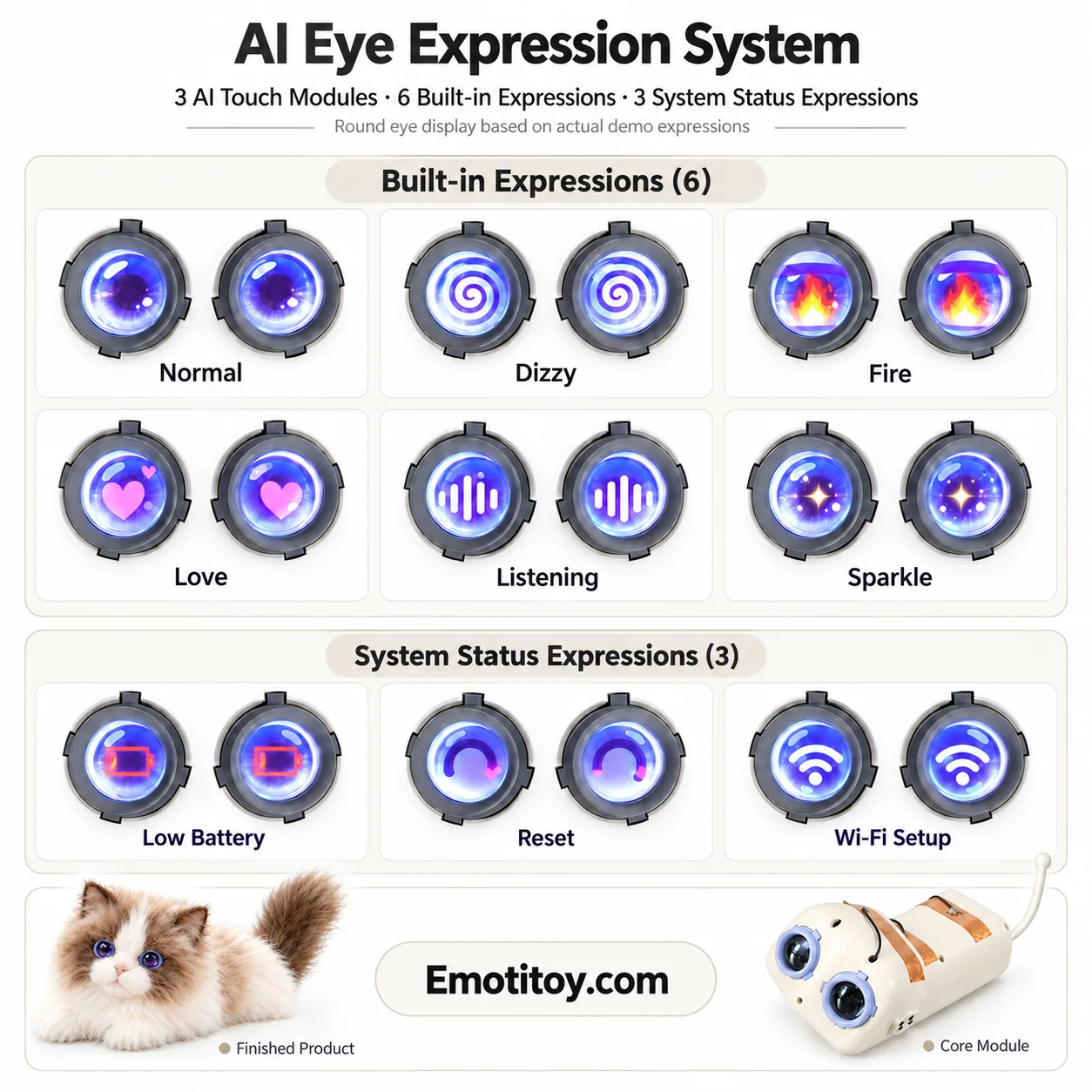
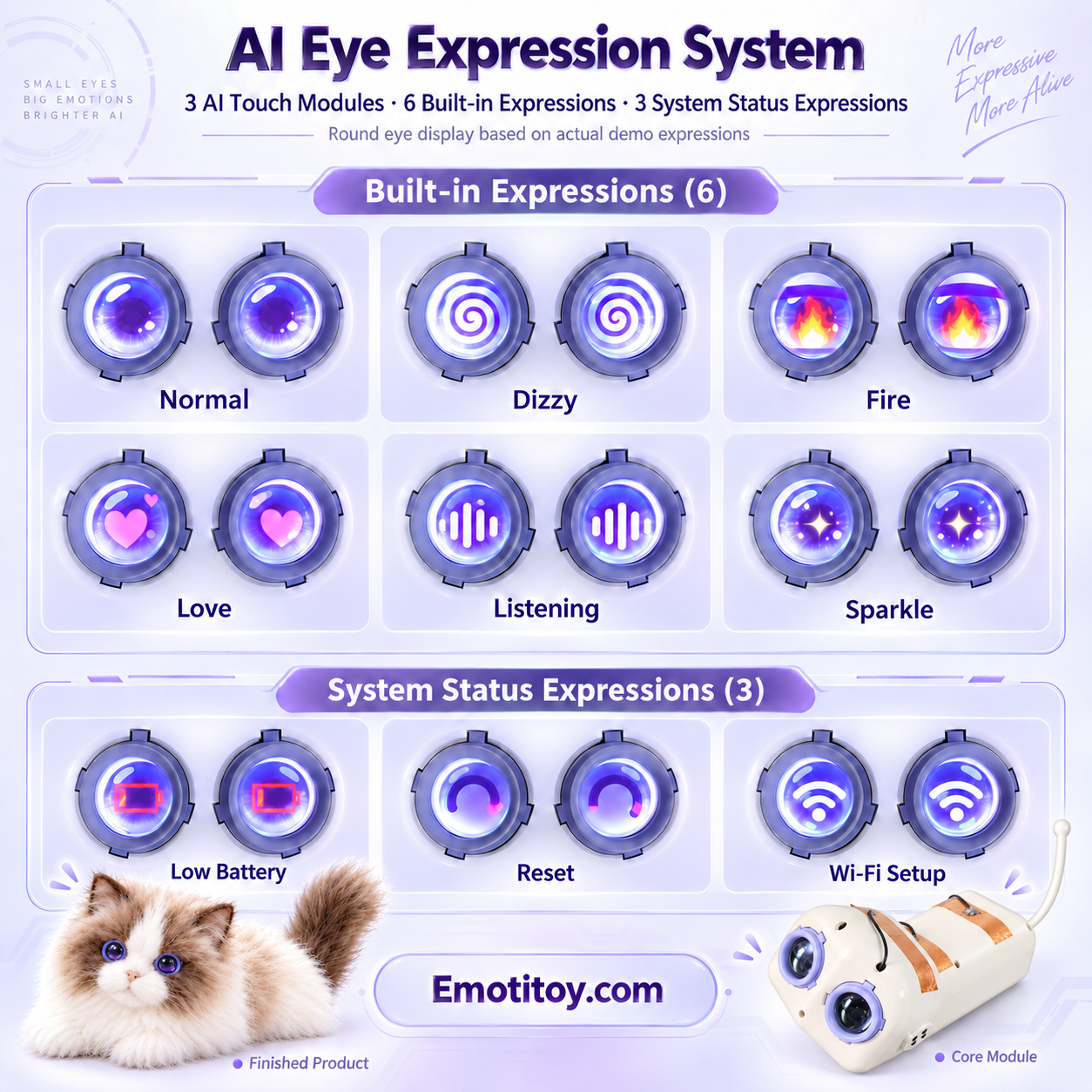
EmotiToy supports AI robot toy OEM/ODM projects combining character design, voice, electronic eyes, touch and servo motion. Existing AI and mechanical platforms can provide a starting point; new locomotion, sound localization, camera tracking and automatic charging need separate feasibility review and engineering evidence.
For a first product, select the interaction that matters most, approve a sample and then define the custom scope. The AI Robot Toy Manufacturer page explains development routes and project requirements. The desktop companion technical guide explains how the systems work together.
Sources and scope
Official manufacturer sources checked on October 8, 2026:
- LivingAI EMO
- LivingAI AIBI
- LivingAI product positioning and EMO GO HOME
- Energize Lab Eilik
- Eilik AI Station
- KEYi Tech Loona usage guide
Features can depend on configuration, firmware, region and service availability. This review does not rank the products or claim equivalent EmotiToy capabilities.