Non-Contact Sensing & Gesture Control Modules
B2B product from EmotiToy, operated by Shenzhen Xunyi Intelligent Electronics Co., Ltd.
Tell us your target quantity, market, and customization requirements.
Product Details
Infrared obstacle detection, proximity triggers and hand gesture interaction for toy cars, robots and plush characters, with EmotiToy OEM/ODM electronics integration.
Non-Contact Sensing for Interactive Toys
EmotiToy develops non-contact sensing and gesture-control solutions for smart toy cars, interactive robot toys and custom plush characters. Detect an approaching object, trigger a contactless response or connect hand movement to programmed sound, light and motion.
This product family covers three distinct functions: proximity detection, obstacle detection and hand gesture interaction. Sensor selection and controller logic are matched to the application; the functions are not automatically combined on one standard PCB.
01 — Infrared Obstacle Detection
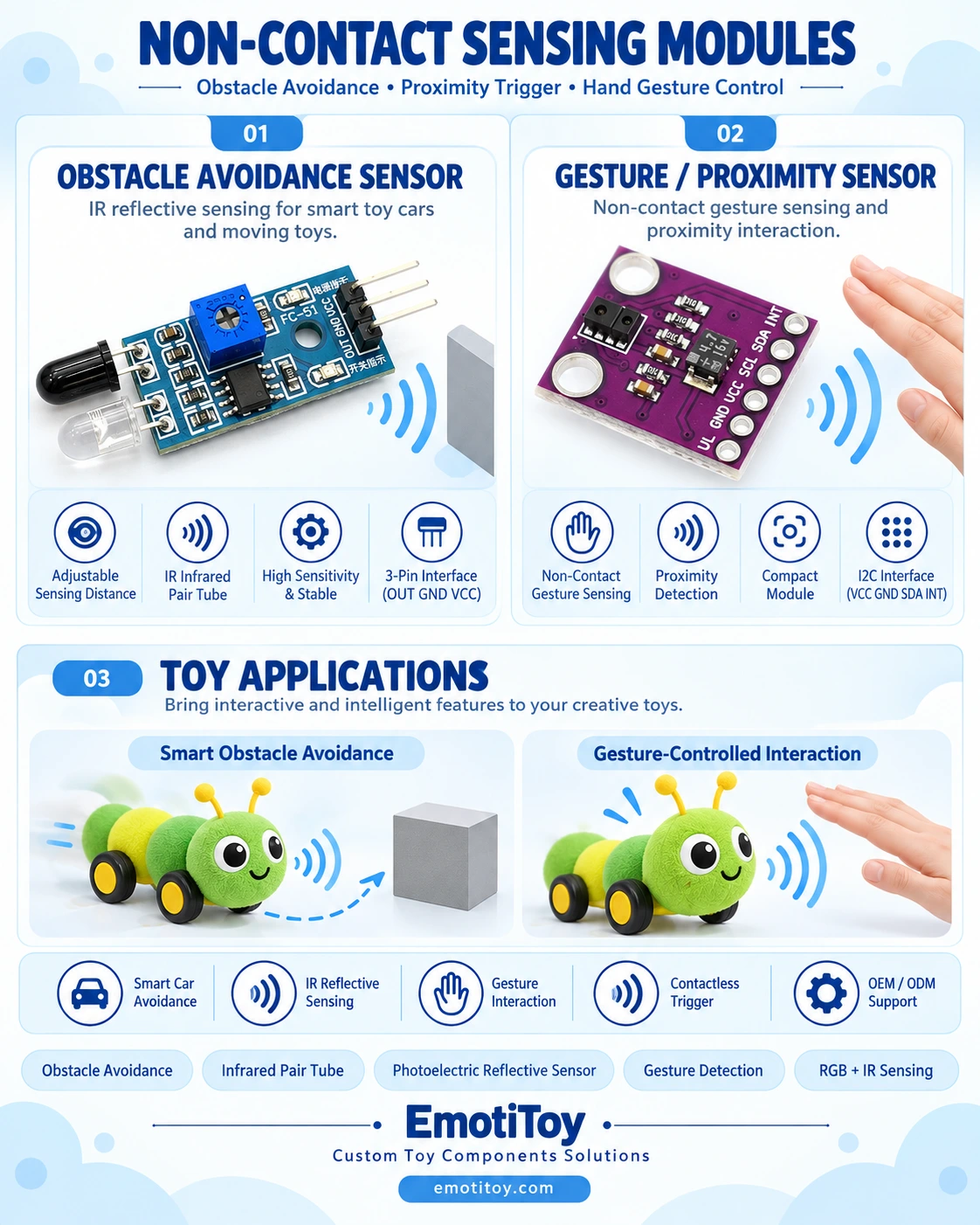
An infrared reflective sensor uses an emitter and receiver to detect reflected light from a nearby target. In a moving toy, the controller can use this signal to stop, reverse or turn away from an obstacle. This is a practical development direction for obstacle-avoiding toy cars, moving character toys and simple robotic pets.
The IR emitter-and-receiver pair, sensing threshold and mounting position are reviewed together. Object color, surface reflectivity, ambient light and approach angle affect detection. A photoelectric reflective sensor provides a detection signal; the controller, motor driver and chassis implement the avoidance movement.
02 — Proximity-Triggered Interaction
A toy proximity sensor detects when a hand or object enters a defined sensing zone, without pressing a button or touching the toy surface. Use a proximity trigger to start an approved sound, illuminate an LED, wake a character animation or initiate a programmed movement sequence.
For plush integration, position the sensor behind a suitable optical window or opening. Fabric and stuffing must not block the sensing path. A non-contact optical sensor is different from a capacitive touch pad designed to detect touch through fabric.
03 — Hand Gesture Control
Gesture sensing adds hand-movement interaction to desktop robots, gesture-controlled toy cars and interactive characters. The sensing system and firmware translate selected movements into configured commands. Sound, lighting, music and motor responses can be coordinated through the toy controller.
Proximity detection alone is not directional gesture recognition. RGB/color sensing, infrared proximity and gesture processing are separate capabilities of the selected hardware. An optical sensor is also not an inertial attitude sensor, and a 2.4 GHz RC link is a separate radio-control function. EmotiToy integrates the functions required by the approved toy design rather than treating these terms as interchangeable.
Existing Robot Application Reference
The AI Dancing Robot — English Version lists hand gesture interaction among its product features. The following existing product video provides an overview of that robot, including movement, audio and lighting. It is an application reference, not evidence that the robot uses either reference PCB pictured in this component infographic, and not a test of specific gesture distances or commands.
Function and Integration Comparison
| Function | Sensor role | Controller response | Application |
|---|---|---|---|
| IR obstacle detection | Detect reflected infrared light | Stop, reverse or turn | Moving toy car or character chassis |
| Proximity trigger | Detect an approaching target | Start sound, light or an action | Robot, desktop character or plush electronics |
| Hand gesture interaction | Detect selected hand-movement patterns | Execute an approved command | Gesture-controlled toy or interactive robot |
| Optional color / IR sensing | Supply selected optical measurements | Apply project-specific interaction logic | Color-responsive and optical toy concepts |
Component Specification Guide
| Item | Product-family specification |
|---|---|
| Product direction | Non-contact sensing and gesture-control integration |
| Sensing options | Infrared reflective detection, optical proximity and selected gesture-sensing configurations |
| Detection targets | Nearby hands, objects and obstacles, according to selected sensing mode |
| Interface options | Digital switching output, interrupt and I2C, according to the selected board |
| Power and logic | Board-specific supply and signal levels; controller compatibility reviewed before connection |
| Detection setup | Threshold, orientation and working zone tuned on the assembled toy |
| Response logic | Local programmed trigger, stop, turn or approved interaction sequence |
| Linked effects | Sound playback, LED effects, music and motor actions through compatible controller outputs |
| Optional integration | Separate motor driver, RC receiver, audio board or light-control electronics |
| Mechanical integration | Sensor window, mounting, cable routing and service access |
| OEM / ODM support | Sensor selection, PCB integration, firmware logic and toy-structure development |
Module dimensions, current consumption, supported gesture commands and tested sensing range belong to the selected configuration. The supplied visuals illustrate module and application directions; they do not define one universal electrical specification or a guaranteed detection distance.
From Sensing Signal to Toy Response
- A hand or object enters the sensing zone.
- The selected optical sensor produces a detection signal or measurement.
- The controller applies thresholds, filtering and programmed response rules.
- The toy executes the approved action through its sound, lighting or motor electronics.
Basic local sensing does not require cloud AI dialogue. If an AI toy also uses this function, sensing and conversation remain separate parts of the interaction system.
Toy Application Directions
- Smart toy cars: obstacle detection and programmed avoidance movements.
- Transforming RC and stunt toys: proximity or gesture commands integrated with a separate control and drive system.
- Interactive robot toys: hand-gesture triggers and coordinated sound, light and movement.
- Plush and character toys: contactless responses with an appropriate sensor opening and internal layout.
- Moving character platforms: selected following or approach-responsive logic developed for the intended target.
The caterpillar and other toy illustrations show application concepts. They are not photographs of a standard finished product supplied with every module. Following behavior requires its own sensing and motion-control design; it is not a default output of a single obstacle sensor.
OEM / ODM Development and Sample Review
Share your toy artwork, available internal space, intended interaction and target market. Define whether the toy should detect presence, avoid an obstacle or recognize selected hand movements. Add the required sound, light and movement responses, battery arrangement and controller information.
EmotiToy reviews sensor placement, wiring and power compatibility, develops the response logic and evaluates the working sample. Sample checks cover the actual target surfaces, ambient lighting, detection consistency, repeated triggers and movement speed. Final approval uses the assembled toy rather than an exposed board alone.
Frequently Asked Questions
Is a proximity sensor the same as a gesture sensor?
No. Proximity detects presence or approach. Gesture interaction identifies selected movement patterns using compatible sensing hardware and processing.
Does obstacle avoidance require AI?
No. A local sensor, controller and motor system can implement programmed obstacle-avoidance behavior without cloud AI.
Can the sensor trigger sound, music or lighting?
Yes. The controller can map approved sensing events to compatible sound, light and motion outputs.
Does the module provide 2.4 GHz remote control or posture sensing?
Those are separate functions. A radio receiver supports remote control; an inertial sensor measures motion or attitude. They can be considered as additional parts of a custom toy system.
How do I request a sample or quotation?
Contact EmotiToy with the intended sensing function, toy size, target quantity and market. Sample scope, development cost, delivery time and production pricing follow the selected configuration.
Explore Toy Components, AI Robot Toys and our OEM / ODM process for related development options.
Product Specifications
- Functions
- IR obstacle detection, proximity triggers and selected hand gesture interaction
- Interface options
- Digital output, interrupt or I2C according to selected board
- Power / Logic
- Matched to the selected sensor board and toy controller
- Linked responses
- Approved sound, music, LED and motor actions
- Applications
- Toy cars, robot toys and custom plush characters
- Customization
- Sensor selection, response logic, PCB and structural integration
Related sourcing resources
Product functions and commercial terms are confirmed for each OEM or ODM project. Review the relevant manufacturing guide before sending your requirements.