
Coming Soon — A Dual-Mode Audio Direction
EmotiToy is preparing a development direction for an AI companion Bluetooth speaker module: one electronic core intended to support connected AI conversation and music streamed from a smartphone.
This is a development preview, not an announcement of an available finished product. The final chipset, supported AI services, dimensions, runtime, sample schedule and commercial terms have not been finalized. We will share product-specific capabilities after hardware and firmware validation.
Two Ways to Use a Companion Product
| Planned mode | Intended experience | What must be validated |
|---|---|---|
| Bluetooth music | Pair a phone and play its audio through the product speaker | Audio profile compatibility, pairing, volume and reconnect behavior |
| Connected AI conversation | Activate a voice session over a network connection | Speech capture, service integration, response playback and recovery |
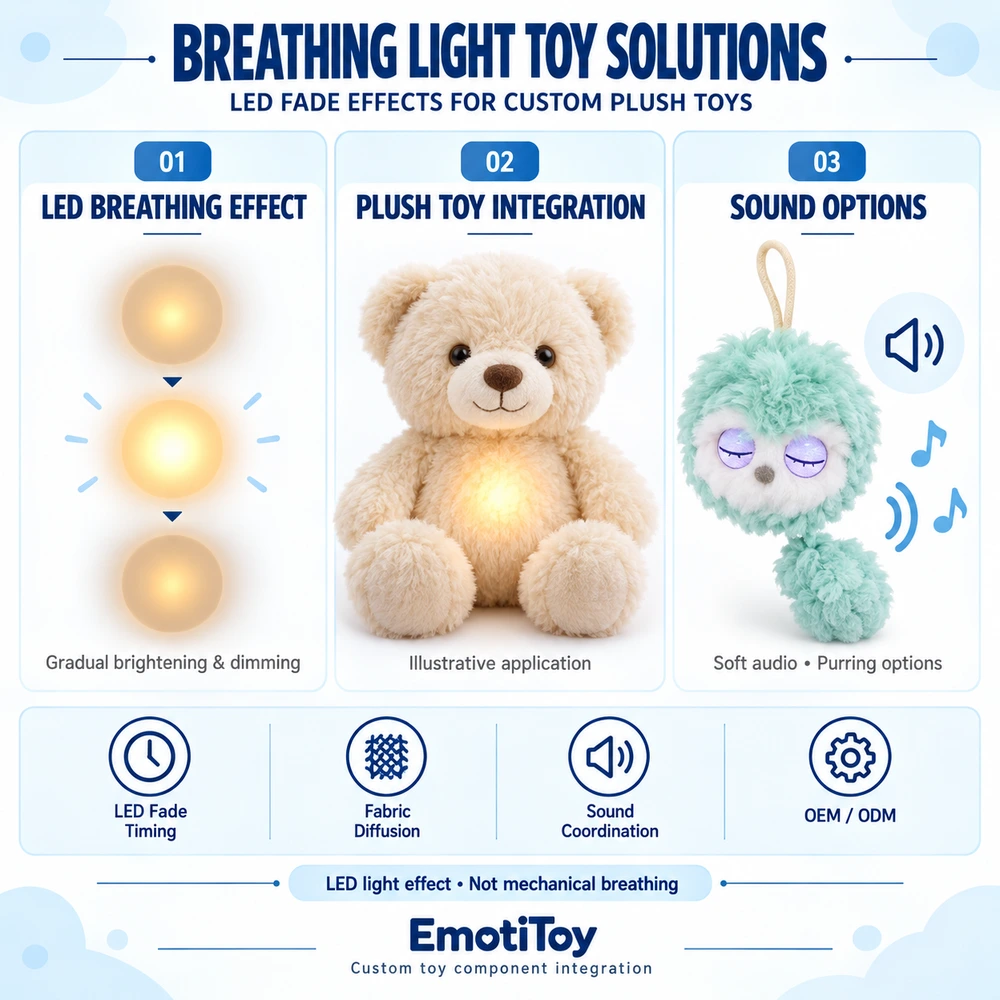
The concept could suit plush characters, desktop companions and bedside products. Optional displays, touch inputs and movement would be evaluated as additional integration scope rather than assumed standard functions.
Bluetooth Audio Is More Than BLE Pairing
A device advertised as supporting Bluetooth may provide only low-energy provisioning or control. That does not establish compatibility with ordinary smartphone music streaming.
For a conventional Bluetooth speaker route, the selected hardware and firmware must support the appropriate audio receiver role. Espressif's A2DP documentation explains source-to-sink audio streaming and provides receiver examples for its supported target. This is a protocol reference, not proof that every ESP32-family device implements A2DP.
We will select a compatible audio architecture rather than infer capabilities from a chip family name. A single-controller solution and a separate Bluetooth audio receiver are different design options, with different space, power and firmware implications. Neither architecture is finalized for this development direction.
One Speaker Needs Clear Audio Priorities
The proposed first-stage experience uses a button to enter AI conversation. Firmware would pause or reduce music according to the approved behavior, give the AI session access to the speaker, and then restore the agreed music state when the session ends.
This transition requires deliberate audio scheduling. The engineering review must define what happens if a phone disconnects, an AI session times out, the network fails or the user switches modes repeatedly. The preview does not promise automatic switching or simultaneous full-volume music and uninterrupted voice recognition.
Voice Performance Must Be Tested in the Product
Microphone placement, speaker leakage, stuffing and fabric can change voice performance. A board that records clearly on a bench may behave differently inside a plush body.
Espressif's audio front-end framework describes acoustic echo cancellation, noise suppression and voice activity detection. These are engineering building blocks; they do not guarantee the finished product's interruption handling or recognition quality.
The development plan should test quiet conversation, playback echo, speech interruption, motor noise where applicable, and reconnect behavior. The same test script should be repeated in each target language and with the intended enclosure.
Development and Validation Stages
- Confirm the board, audio interfaces and supported Bluetooth audio profile.
- Verify microphone capture and speaker playback independently.
- Demonstrate smartphone music pairing, playback and reconnection.
- Integrate a selected real-time AI service and evaluate the target languages.
- Implement and test the audio mode transitions and error recovery.
- Review power consumption, enclosure acoustics and any display or motion features.
- Define production tests, service responsibilities and the approved product specification.
Grok, OpenAI or other services may be evaluated according to the selected architecture. No provider compatibility, perpetual free service, specific API price or response-time guarantee is announced here. AI usage terms and ongoing operating costs will be reviewed separately from Bluetooth audio playback.
OEM / ODM Project Discussions
We welcome requirements from brands exploring this product direction. Share your character or enclosure concept, available space, target market, required languages, Bluetooth music expectations and estimated quantities. Identify whether you need a complete product, an enclosed module or custom electronics.
Engineering, firmware integration, tooling, sample fees, MOQ and production timing will follow project review. Coming Soon indicates a planned development direction; it is not a confirmed delivery date or an invitation to place a stock order.
Explore our buyer-owned AI integration service, ESP32-S3 module development route and voice interaction test guide. Contact EmotiToy to discuss a development brief.
Technical References
- Espressif A2DP API and audio receiver examples: reference for Bluetooth source/sink audio roles on the documented target.
- Espressif Audio Front-end Framework: reference for speech-processing functions and audio input configuration.
References reviewed October 24, 2026. External documentation describes its own hardware and software; EmotiToy's final implementation remains subject to validation.